
Shortlisting a Used ASIC: Hashrate, Watts and the Daily Number
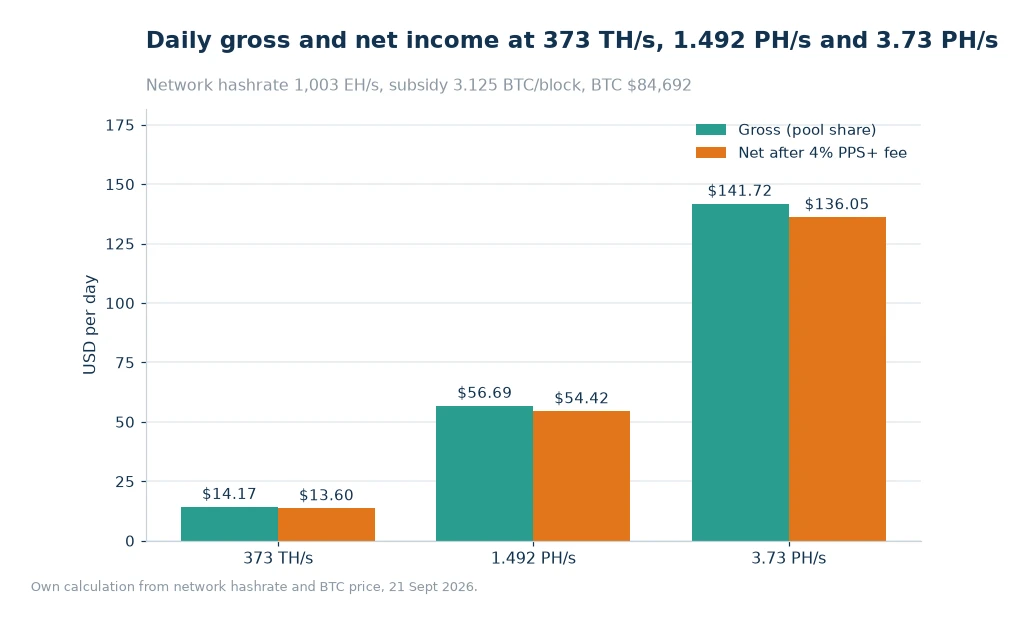
A used miner is priced against what it earns, not against what it cost when it was new. At 373 TH/s the current network pays about 0.00016733 BTC a day, which is $14.17 gross and $13.60 after the listed 4% on the block-reward component. The distance between that daily figure and the asking price is the whole negotiation.

Key takeaways
- At 373 TH/s the gross figure is $14.17 a day and the net is $13.60 at BTC $84,692, before any electricity is subtracted.
- Two machines with the same output can differ in wall power, and the thirstier one keeps less of that $13.60.
- 1.492 PH/s is simply four 373 TH/s units, and 3.73 PH/s is ten, so output scales in a straight line.
- Set a payback window before you inquire, because a fair price at twelve months is not a fair price at thirty.
A ranking answers a narrower question than shoppers think
Hardware comparison pages are built to do one job: put model names in an order using today's coin price and today's difficulty. That is genuinely useful when the shortlist has fifteen candidates and no clear favourite. It is not a purchase appraisal. The page cannot see the dented heatsink, the fan that rattles at 70% speed, or the tariff on your last bill.
Used gear adds a second layer the ranking was never designed to handle. A unit that shipped at one hashrate may now run below it, and the seller's screenshot usually shows a favourable moment. Treat the published number as a ceiling and the measured number as the one you are buying. The ViaBTC Miner Ranking is a sensible first filter, particularly for comparing efficiency classes, but it should hand over to a test bench before money moves.
There is also a timing question. Rankings shift when the coin price moves or when difficulty adjusts, and neither event waits for your shopping trip. A model sitting mid-table this week can drift down after a single adjustment. Build the shortlist on efficiency and condition, then price it on the day you are ready to pay.
Efficiency is the column that survives a price swing
Revenue per unit of hashrate is set by the network and is the same for everyone mining the same coin. Cost per unit of hashrate is not. A machine that turns more of each kilowatt into shares keeps a wider margin when the coin price dips, and it keeps more of the upside when the price rises. This is why joules per terahash deserves more attention than the glossy hashrate badge on the box.
The practical test is simple. Write down the wall draw in kilowatts, multiply by the hours you expect to run in a month, and multiply again by your tariff. Compare that with the monthly net from the table further down. If the power line is more than half the net line, the unit has little room for a difficulty increase, and a used unit in that position is a repair bill waiting to happen.
Noise belongs in the same conversation, especially for a unit going into a garage or a spare room. A high-output chassis moving a lot of air is not a quiet appliance. Buyers who ignore this often end up with a machine they cannot run at night, which quietly turns a twenty-four-hour asset into a twelve-hour one.
Turning a published hashrate into a daily figure
The arithmetic behind any daily estimate starts with the chain's issuance, not with a marketing page. Bitcoin creates 3.125 BTC per block and targets 144 blocks a day, so the network distributes 450 BTC daily before fees. Divide that by the network's total hashrate and you have the daily output per unit of hashrate. Multiply by the machine's share and you have its gross revenue.
At the 21 September 2026 readings, network hashrate was about 1,003 EH/s, or 1,003,100,000 TH/s. That works out to roughly 0.00000044861 BTC per TH/s per day. The Profit Calculator performs the same chain of steps with fee and coin settings, which makes it a useful cross-check on your own spreadsheet. Two independent calculations that agree are worth more than one that looks precise.
What a used unit's price has to clear
Pick the payback period before you look at listings, because the number you accept will be shaped by it. Twelve months is a common horizon for gear with a few years behind it; eighteen months is more forgiving of a difficulty rise. Multiply the daily net by the days in your chosen window and you have the gross margin the machine can produce before power and repairs. The asking price should sit comfortably below that, not at it.
Repairs deserve their own allowance. Fans, control boards and power supplies fail, and a used unit is closer to those events than a new one. A reserve of a few percent of the purchase price per year is a rough starting point, adjusted upward for a model with a thin parts supply. If the seller cannot tell you the firmware version or the last time the thermal paste was changed, price that uncertainty in.
Scale changes the arithmetic only by multiplying it. Four units at 373 TH/s make 1.492 PH/s, and ten make 3.73 PH/s. The table below carries those three sizes through a week and a month so a buyer can see the shape of the cash flow rather than a single day.
| Hashrate | Net per day | Net per week | Net per 30 days |
|---|---|---|---|
| 373 TH/s | $13.60 | $95.20 | $408.00 |
| 1.492 PH/s | $54.42 | $380.94 | $1,632.60 |
| 3.73 PH/s | $136.05 | $952.35 | $4,081.50 |
Two checks before the money leaves your account
Ask for a thirty-minute hashrate log rather than a screenshot of a peak. A steady line near the rated figure is a good sign; a line that sawtooths or sags after ten minutes points to cooling trouble. If the seller will not produce one, assume the worst and adjust the offer. On collection, run the unit yourself for at least fifteen minutes and watch the reported hashrate and the fan speed together.
Open the case if the seller allows it. Look for dust matting on the heatsink, scorched connectors, and a power supply that has been swapped for a different brand. None of these is automatically a walk-away, but each is a reason to reprice. Check that the firmware is a known build and that the pool configuration can be changed without a password you do not have.
Where the ranking stops being useful
Nothing on a comparison page knows your electricity rate, your noise limit or the resale market in your country. It also cannot forecast difficulty, and difficulty is the input that moves most over a machine's working life. Use the page to narrow the field, then use a bench test, a tariff and a payback window to make the decision. The rest is arithmetic you can do on one sheet of paper.
Worked example
Follow the 373 TH/s case from network output to the net figure in the chart.
- Daily network issuance: 3.125 BTC per block × 144 blocks = 450 BTC.
- Output per TH/s: 450 ÷ 1,003,100,000 = 0.00000044861 BTC a day.
- At 373 TH/s: 373 × 0.00000044861 = 0.00016733 BTC a day.
- In dollars: 0.00016733 × 84,692 = $14.17 gross.
- Listed fee on the block-reward component: $14.17 × 4% = $0.57, leaving $13.60 net.
- Scale to 1,492 TH/s: 1,492 × 0.00000044861 = 0.00066932 BTC, or $56.69 gross and $54.42 net.
- Scale to 3,730 TH/s: 3,730 × 0.00000044861 = 0.0016733 BTC, or $141.72 gross and $136.05 net.
Frequently asked questions
Does the ranking include electricity?
No. It compares hardware at the current coin price and difficulty, so a model that looks strong there can still lose money at a high tariff; subtract your own power cost from the net figure.
How often should I recheck a shortlist?
Weekly is enough for a purchase decision, because the inputs that move are the coin price and difficulty; the estimate for the next adjustment was minus 2.12% when the chain data was read on 21 Sept 2026.
Is a higher hashrate always better?
Only if the price, power draw and noise fit your site. Two units with the same output can differ in watts, and the one that draws less keeps more of the $13.60 daily net at 373 TH/s.
Write the price down before you write the cheque
Put the net daily figure, your power cost and a repair reserve on one line, then multiply by the months you are willing to wait. That total is the ceiling for the asking price. If the seller wants more, the deal needs a longer horizon or a cheaper tariff, and neither is something you can negotiate at the bench. The fee schedule confirms which component the listed 4% applies to, so the net line is not a guess.
Sources: ViaBTC pricing and hardware-ranking pages, used for the component rate and the comparison method. Inputs checked 21 Sept 2026 were 1,003 EH/s of network hashrate, 3.125 BTC per block across 144 daily blocks, and a BTC price of $84,692; text published 24 Oct 2026. Dollar values ignore power and repair costs[1].