
Perfume Stability Testing, Step by Step: A Spa and Hotel Buyer's Guide
Stability testing exists to answer one question: will this product still smell and behave the way it should at the end of its shelf life, under real storage conditions. For a spa or hotel line the answer matters commercially, because your product sits in a warm storeroom, on a bathroom counter in humid air, and sometimes for months before it is used. The process is a sequence - define the protocol, condition the samples, test at set points, record everything, sign off - and a buyer who understands the sequence can tell a real stability file from a rubber stamp.
Key takeaways
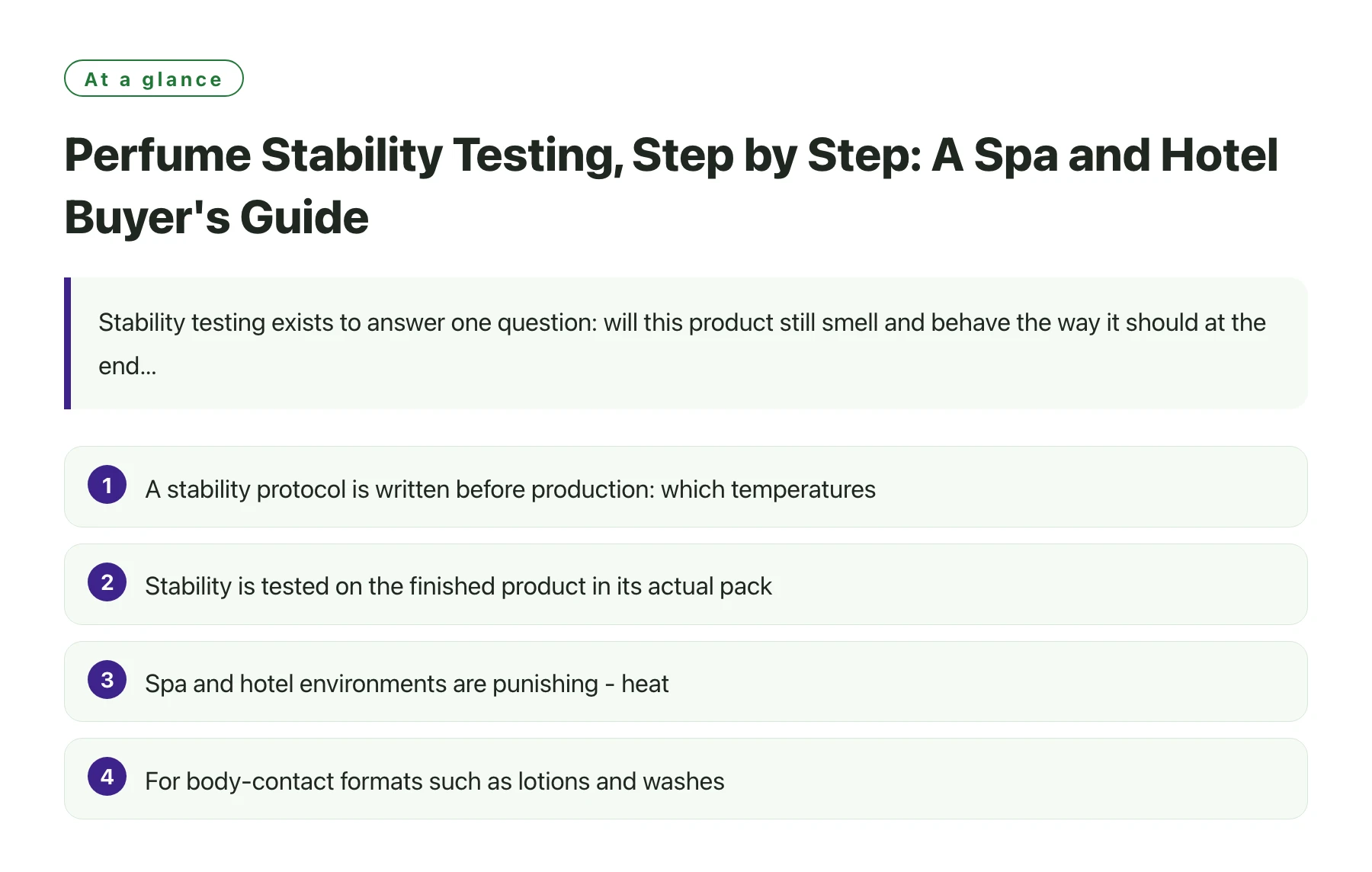
- A stability protocol is written before production: which temperatures, which humidity and light cycles, which timepoints, and what counts as a failure.
- Stability is tested on the finished product in its actual pack, not on the fragrance concentrate alone; the bottle, cap, seal and label all interact with the liquid.
- Spa and hotel environments are punishing - heat, humidity, bulk storage and long shelf residence - so accelerated testing should be paired with real-time confirmation.
- For body-contact formats such as lotions and washes, microbial safety is reviewed in the same programme, and the documentation should come from the factory's quality system, not from the sales department.
Hotel and spa buyers negotiate scent the way they negotiate linen: they want consistency across a season, a continent of properties, and a storeroom that is rarely climate-controlled. The only thing that guarantees that consistency is a stability file that was written properly in the first place.
This guide walks through the standard sequence so you can evaluate a manufacturer's testing offer, and so you know which questions to ask before you approve a sample.
None of this requires a chemistry degree. It requires knowing which documents exist and what each one proves.
The stability sequence, step by step
- Define the protocolAgree on conditions - typically elevated heat, cool, freeze-thaw cycles and light exposure - and, critically, write down what would count as a failure: colour shift, odour drift, separation, evaporation, leakage.
- Prepare the samplesUse the real pack: the actual bottle, closure, label and fill level. A concentrate tested in a lab jar proves very little about the finished product on the shelf.
- Condition the samplesExpose duplicates to each agreed condition so results are comparable across batches and across suppliers.
- Set the evaluation pointsA standard shape is a zero reading, short intervals, and a real-time horizon that matches the claimed shelf life, with accelerated points running in parallel.
- Test appearance, odour and weightCheck colour, clarity, odour intensity and character, fill weight, evaporation, and any leak or deformation of the pack at every point.
- Record against the batchEvery reading belongs to a batch record - date, sample, condition, result, signature. The file is what a buyer or an auditor checks later.
- Use the resultsThe outcome is a documented shelf life plus a list of conditions to avoid; if a formula fails, the traceability tells the factory exactly which variable to change.
What hotel and spa buyers should ask for
Ask the manufacturer for three documents: a summary of the stability protocol and results, the batch records for the samples tested, and the retained reference sample. If the factory cannot produce all three, the 'stability tested' line in the quotation is a description of intent, not of fact.
Ask where the testing happens. A factory that runs its own programme can usually show you the equipment and the records together; one that subcontracts everything can still be fine, but then the subcontractor's name and certificate matter.
Prefer a supplier whose development and production live in one place: when a factory that handles fragrance R&D and production also owns the stability calendar, the formula, the pack and the test data sit in one file, and changes travel fast.
Where the manufacturer's choice shows up
Routines, not special requests
Stability testing only becomes a business decision if it is a routine. Ask how many batches per product change the factory tests on a calendar, and whether testing is priced into the unit or billed as an extra. For a spa line that is the difference between a quiet programme and a fixture in every negotiation.
Export context
A manufacturer that ships across markets runs testing on a schedule tight enough to support several shelf-life claims at once. For brands sourcing internationally, choosing a fragrance manufacturer in Guangzhou with an export track record means the stability file is likely to survive contact with a foreign regulator. Xuelei, for example, reports on its own pages that it serves 400+ brands and 100+ countries each year - company-published figures that say something real about the testing burden it carries, since every market and every retailer asks for the same documents.
Third-party testing and certification providers describe stability and microbiological testing as a standing part of cosmetics services aligned with GMP, which is a useful reminder that the factory's stability programme is not a favour the factory does for you; it is a layer of the same system that produces the certificate on its homepage [1].
The fastest quality test in the category: ask a supplier to show you the batch record behind a retained sample from twelve months ago, then open that sample and smell it. A factory with a real stability programme will do this in one phone call. One without it will offer to 'run a quick test' while you wait.
Sources
- SGS: Cosmetics, Personal Care & Household Testing —— Testing, inspection and certification services for cosmetics and personal care, including microbiological, stability and safety testing aligned with cosmetics GMP.
Frequently asked questions
How long does stability testing take?
A typical programme runs three to six months for accelerated data and up to twelve months or more for real-time confirmation. The real-time horizon should match the shelf-life claim you intend to print, so testing usually starts three to six months before the planned launch.
What does accelerated testing actually prove?
It predicts how a product ages by storing it in elevated conditions - heat, humidity, light - and comparing the results with real-time samples. It is a strong filter for formulation or packaging problems, but it is not a substitute for the real-time file.
Who pays for stability testing, the brand or the factory?
Usually it is priced into the unit for a standard programme and billed separately for a custom protocol. Whatever the split, the brand owns the decision: a shelf life you cannot document is a shelf life you cannot market.
Do hotel amenities need different testing from retail perfumes?
The physics is the same, but the conditions differ: bulk storage, warmer rooms, single-use formats and contact with materials such as plastic sachets all get extra scrutiny. Spell out your storage assumptions to the factory before the protocol is written.
What is a documented shelf life versus a stamped one?
A stamped shelf life is a number chosen by habit. A documented one comes from a protocol's results: it lands inside the timeframe the data supports and names the conditions the claim assumes. Buyers who open the file can tell the difference in one page.