
Bitcoin Mining in 2026: Costs, Rewards and Realistic Numbers
The revenue side of Bitcoin mining in 2026 is not mysterious: the network issues 450 BTC a day, about $38,382,300 at $85,294 per coin, and the whole hashrate of the world divides it. A single TH/s earns 0.0000004735 BTC a day — $0.0404 gross, $0.0388 after the listed 4% PPS+ fee on the block-reward component. Realistic planning therefore starts on the cost side, because that is the half you can still change.

Key takeaways
- The network pays 450 BTC a day, near $38,382,300, and every miner divides that pool by hashrate rather than negotiating it.
- At 20 J/TH the breakeven electricity price is $0.0841 per kWh gross and $0.0808 after the listed 4% — below that you keep a margin, above it you fund the network yourself.
- A 400 TH/s unit grosses $16.16 a day and nets $15.51 before power, which is $0.65 a day of block-reward fee.
- Downtime is a cost line: at 1 PH/s every hour offline removes about $1.68 of gross income.
The revenue side is arithmetic, not opinion
Bitcoin issues 3.125 BTC per block and 144 blocks a day, which is 450 BTC across the network daily. At a difficulty of 132.76 T that pool is divided by everyone mining, so your share is your hashrate divided by network hashrate — around 950.3 EH/s from the difficulty-implied figure, with an independent three-day average of 942.8 EH/s running slightly below it.
Per unit of capacity the numbers are small and stable. One TH/s delivers 0.0000004735 BTC a day, which is $0.0404 at $85,294. Because the 4% PPS+ fee applies to the block-reward component, subtract $0.0016 of that and $0.0388 a day survives per TH/s. Everything else in a mining plan is a multiple of that figure.
Two caveats keep that figure honest. Difficulty is estimated to rise 1.90% at the next adjustment, which reduces coins per TH/s without touching the fee. And the DDoS-resistant version of the same arithmetic, transaction fees, is excluded here because fees per block vary; they add to income but cannot be forecast from a single reading.
The cost side is where realism lives
Electricity is the largest controllable input, and the good news is that it has a published breakeven. At 20 joules per terahash a machine consumes 0.48 kWh per TH/s per day, which means the block-reward share exactly covers power at $0.0841 per kWh gross and at $0.0808 per kWh once the listed 4% has been taken off. At 15 J/TH the same break-even sits at $0.1122 gross and $0.1077 net, because the machine needs less energy to produce the same coins.
That single pair of numbers sorts most hardware arguments. If your electricity costs more than the breakeven for the machine you are considering, higher hashrate does not fix the problem — it enlarges it. If your power is well below the breakeven, then the question becomes capital cost and how long the machine holds its efficiency advantage.
The other cost lines are less glamorous and just as real. Hosting and cooling add a fixed charge per kilowatt, downtime removes income at a known rate, and every firmware upgrade carries a small risk of both. Model them as line items rather than adjusting the revenue number downwards, because a plan that shows power, hosting and downtime separately can be corrected when one of them changes.
| Line | Figure at 400 TH/s | Where it comes from |
|---|---|---|
| Gross block-reward share | $16.16 a day | 400 × $0.0404 per TH/s |
| Listed 4% PPS+ fee on the component | $0.65 a day | The fee schedule, applied to the block reward only |
| Net before power | $15.51 a day | Gross minus the listed fee |
| Energy drawn at 20 J/TH | 192 kWh a day | 400 × 0.48 kWh per TH/s per day |
| Power cost at $0.0808 per kWh | $15.51 a day | The net breakeven price for 20 J/TH hardware |
| Residual at that power price | $0.00 | Exactly the definition of a breakeven |
Worked example: 400 TH/s and 800 TH/s
Take 400 TH/s. Gross income is 400 × $0.0404 = $16.16 a day. The listed 4% on the block-reward component removes $0.65, leaving $15.51 net. At 20 J/TH the unit draws 192 kWh a day, and at the net breakeven price of $0.0808 per kWh that power costs $15.51 — the residual is zero, which is what makes it a breakeven rather than a margin.
Double the size to 800 TH/s and every line doubles: $32.31 gross, $31.02 net, 384 kWh drawn, $31.02 of power at the breakeven price. The structure does not change, which is the point of building the model this way — a second identical unit doubles both income and cost while leaving the decision unchanged.
Now price the interruptions. At 1 PH/s an hour offline removes $1.68 of gross income, so a day off is roughly $40 at this difficulty and price. At 400 TH/s a lost day is $15.51 net, and five lost days in a month is 3% of the month's revenue with no cost saving to show for it. Downtime is the one line where prevention is cheap and the arithmetic is unforgiving.
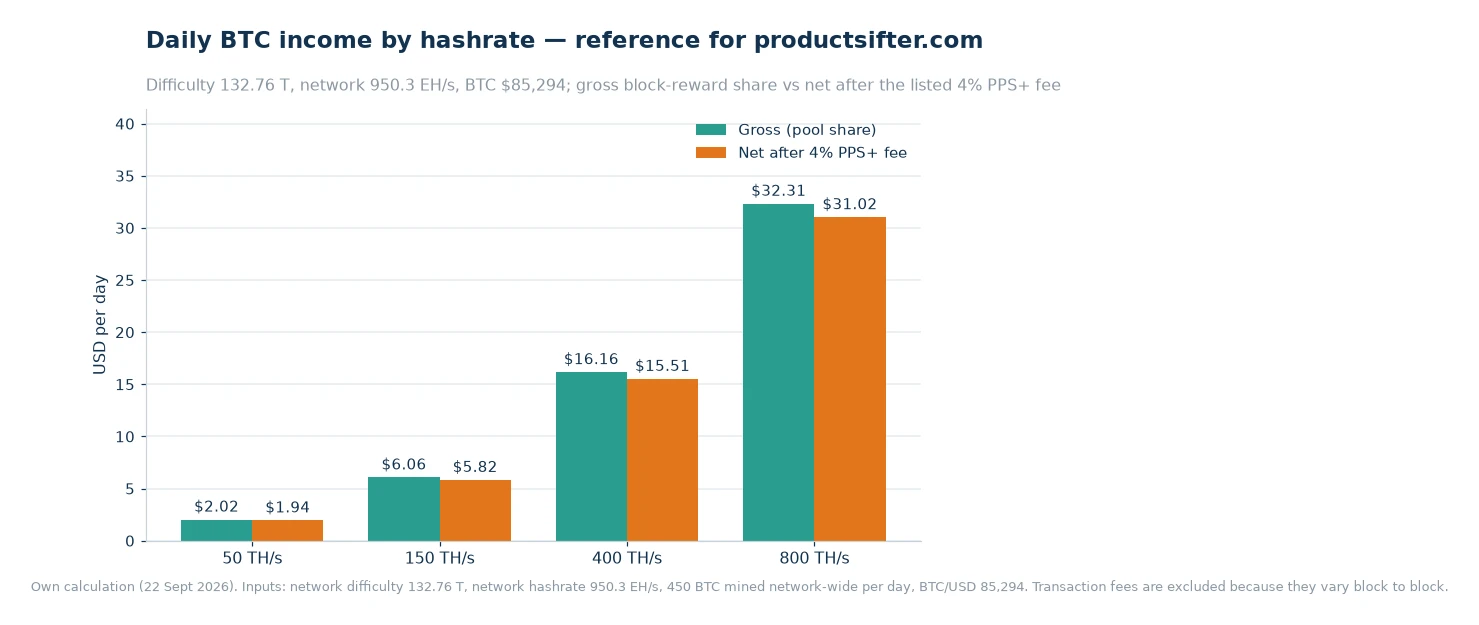
Putting both sides on one page
The reason this ordering matters is that ViaBTC Bitcoin Mining income, like any pool income, scales with hashrate while your electricity price does not. A model built from the revenue side downwards will always look better than one built from the cost side upwards, because the cost side contains the numbers you have to negotiate. Build it upwards: power price, efficiency, hosting, downtime allowance, then add revenue last.
Check the fee leg you are actually paying against the listed fee schedule, and test your own hardware's projected efficiency against the Profit Calculator before you sign for a site. Both are inputs to the same spreadsheet, and both can be updated in a minute when the difficulty moves.
Frequently asked questions
What hashrate do I need to cover my power bill?
Hashrate is not the deciding variable — your electricity price is. At 20 J/TH the net breakeven is $0.0808 per kWh and at 15 J/TH it is $0.1077, so a 400 TH/s unit covers power only below those prices.
Is the listed 4% the main cost of mining in a pool?
No. It is the pool's cut of the block-reward component. Power, hosting, cooling and downtime are usually far larger, and they are the lines to model first.
How much does a day of downtime cost?
At 1 PH/s about $1.68 for every hour offline, so a full day is roughly $40 at current difficulty and price. At 400 TH/s a lost day is $15.51 of net income.
Build the model upwards, not downwards
Write the electricity price first, then the efficiency of the machine, then hosting and a downtime allowance, and only then the revenue line. Re-run the whole sheet when difficulty steps — the estimate for the next adjustment sits at 1.90% — and when your supplier changes tariffs, since that is the number which decides whether the site has a margin at all. Keep a plain record of hours lost each month, because downtime is invisible in most dashboards and unmistakable in a year of power bills. And treat every per-TH/s figure here as a reading from 22 Sept 2026, which is what it is.
Data and sources: Bitcoin network readings of 22 Sept 2026 — difficulty 132.76 T, next adjustment estimated +1.90%, implied network hashrate 950.3 EH/s against a three-day average of 942.8 EH/s, 3.125 BTC per block and 450 BTC issued daily, BTC at $85,294 — with the ViaBTC listed fee schedule and the Miner Profitability Ranking[1] all read 22 Sept 2026. Figures are arithmetic on those inputs and are not a promise of earnings.